|

Custom Search
|
 Pet
Pet
Pet Food Labelling -
| ||||||||||
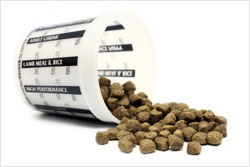
| Burns Chicken & Brown Rice Brown Rice (min 63%), Chicken (min 20%), Oats, Peas, Chicken Oil, Sunflower Oil, Seaweed, Vitamins and Minerals |
Pets at Home Adult Complete Dog Food with Chicken Fresh Chicken, Poultry Meat Meal, Maize, Rice, Barley, Maize Gluten Meal, Animal Fat, Sugar Beet Pulp, Poultry Digest, Brewers Yeast, Egg Powder, Flaxseed, Potato Protein, Sodium Chloride, Potassium Chloride, Methionine, Marigold Extract, Yucca Extract, L-Carnitine, Rosemary Extract, With Antioxidant EC Additives (Vitamin E and Vitamin C) Contains Tocopherol Rich Extracts Of Natural Origin Vitamin E and Vitamin C As EC Permitted Antioxidant, No Added Colourants, Flavourings Or Preservatives. |
Comments: On the surface, it's a good recipe with very few ingredients and nothing untoward. BUT.... that 'chicken' should read 'chicken meat meal', there's no 'chicken digest' declared and no mention of the vitamins and minerals or antioxidants/preservatives used, despite the fact that they are. Not exactly user-friendly! |
Comments: Pets at Home have taken a more open approach and made sure that they give their customers a fuller list of what's in the food. Good to see them open about using digest, declaring the meat meal and minerals/antioxidants. It might be a longer ingredients list, but it could also be argued that this is a more ethical approach. |
If you want to know more about what's in the food that you feed your pet then ask the manufacturer. If it's not on the label then ask them why!
Regulations
The labelling of pet foods is covered in the UK by the Feeding Stuffs Regulations 2005, and this applies even to the pet shop that empties food into a bin and sells from that - you have a right to know the ingredients and analysis of that food, plus handling and storage information.
This is called a Statutory Statement and covers everything other than 'straight' foods ('vegetable or animal product in its natural state, fresh or preserved, and any product derived from the industrial processing thereof, and any single organic or inorganic substance, whether or not it contains any additive intended as such for oral animal feeding' )
Straight pet foods must be labelled with their net weight and the name and address of the packer
For pet food ingredients - follow
this link
Also check out 'Antioxidants
in pet food'
Statutory statement
The supplier will provide the statement either on the package or in an accompanying document. It must be in a separate panel from other labelling. Sometimes it is on a label sewn into the top of the bag or it may be printed on the bag itself.
When selling pet food loose from bins or other retail displays, the statutory statement must be displayed in a prominent place. It might for example be attached to the bin or with the food in such a way that it is clear to which product it relates.
If a shop makes up pre-packed containers of less than 10kg for sale to the consumer, a similar display notice can be used. For other pre-packed goods greater than 10kg, the shop must mark each pack with the statutory statement.
When the statutory statement is displayed on a notice, care must be taken to make sure any use-by or best-before date and any batch number is updated when new stock is added.
At all times the statutory statement must be clear and visible.
What needs to be on the label?

It is not just branded cans and packs of pet food that need to be labelled correctly. Pet food that is sold either loose from bins, hoppers or other retail bulk displays or in small pre-packs broken down from larger packs must be correctly labelled.
Statutory Statement
The Feeding Stuffs Regulations 2005 require a statutory statement
to be put on every label or package which must contain certain obligatory
declarations.
Direction & Description
These must state: -
• whether the product is complete or complementary;
• the species for which the product is intended;
• directions for use.
Typical Analysis
The percentage of the following must be listed:
• % of proteins
• % of oils & fats
• % of fibre in the product
• % of moisture in the product when it exceeds14%
• % of ash in the product (ash represents the mineral content
of the food and is determined chemically by the burning of the product).
Ingredients List
The ingredients must be listed in descending order by weight. They
can be indicated using category names, which are laid down by the
Regulations, such as 'meat and animal derivatives', 'cereals', 'derivatives
of vegetable origin'. Alternatively ingredients can be listed by
their own individual names*. When an ingredient is used that does
not fall into any of the prescribed categories, its individual name
must be listed. In all other circumstances, mixing individual names
and category names in the ingredients list is not permitted. If
particular attention is drawn to a specific ingredient (eg With
Chicken), the percentage of that ingredient component must also
be listed.
Small Animal Feed Labelling
Ingredients may be declared in the Statutory Statement. In such
cases, all the ingredients shall be declared either by their specific
names, with an indication of the amount of each ingredient, or by
using category names which are laid down by the Regulations, or
by individual ingredient names listed in descending order by date.
Additives
If preservatives, antioxidants or colourants have been added to
the product their presence has to be declared using category or
chemical names, in accordance with the Feeding Stuffs Regulations.
If a pet owner has any queries regarding additives, they should
contact the individual manufacturer responsible, quoting the batch
number.
Vitamins
If Vitamins A D & E are added to the product, their presence
and level has to be declared. The level must include both the quantity
naturally present in the raw materials and the quantity added. The
Regulations also lay down the units which must be used to declare
the level.
'Best Before' Date
This date indicates the minimum storage life of the product. The
month and year must be shown.
Bar Code
This is not a legal requirement but allows for information about
sales, stocks, etc.
Batch Number
A batch number or the date of manufacture must be given to facilitate
traceability of the product. This may be given either in the statutory
statement or elsewhere on the package/label/container, in which
case the statutory statement shall indicate where it can be found.
Net Weight
The Net Weight must be given in accordance with the Feeding Stuffs
Regulations 2002. The Weights and Measures (Packaged Goods) Regulations
1986 lays down the exact marking and size of lettering required.
The net weight may be given either in the Statutory Statement or
elsewhere on the packaging/label, in which case the Statutory Statement
should indicate where it may be found.
Name and Address
This is the name and address of the company responsible for the
products. It may be a manufacturer, packer, importer, seller or
distributor.
The above is the minimum information which must be provided.
Other labelling
Pre-packed pet foods must be labelled on each pack with the net weight. This must be in metric units. A statement in imperial units is optional. Pet foods in biscuit or cake form in packs of no more than 16 may be sold by number.
Failing to comply with these requirements is a criminal offence. The maximum penalty on conviction in a magistrates court is a fine of £5,000.
Deciphering pet food labels
It can be difficult to compare foods because of the moisture content (i.e. dry diets average 10% water, but moist foods can have 80% water content) and the fact that labels list levels as an 'as fed' rather than 'dry matter' basis which would enable customers to directly compare the different foods.
If you want to convert 'as fed' to 'dry matter' a simple conversion is necessary. Are you ready?
-
If a dry food is 10% moisture then it is 90% dry matter (Still with me?)
-
If the declared protein content is 20%, then the maths is 20 x (100/90) which gives us the protein on a dry matter basis of 22%.
-
Compare this to a canned or pouch food which declares a protein content of 5%. This food contains 80% moisture (or only 20% dry matter) so the maths is 5 x (100/20) or 25% protein on a dry matter basis.
You'll find this with the majority of canned foods, the actual protein content is higher than that of dry complete foods when compared on a dry matter basis. You can do the same for fat, fiber, etc.
Latest Offers from Top Online Pet Stores |

|
|
|
 |
 |

- Home
- Antioxidants
- Animal Testing
- Articles
- Feedback
- Food Ingredients
- Food Intolerance
- Links
- Our Top Pet Foods
- Overweight Pets
- Pet Food Labels
- Pet Food Cost
- Rabbits
- Save Money!
- A Gift of Flowers!
Current Reviews
Acana Wild Prairie
Alpha
Applaws
Arden Grange
Autarky
Bakers
Barking Heads
Beta
Burgess Supa Dog
Burns Pet Nutrition
Eden
Gusto
Eukanuba
Fish4Dogs
Harringtons
HiLife
Hills Pet Nutrition
Iams
James Wellbeloved
JB Good Food
Laughing Dog
Lilys Kitchen
Natural Dog Food Co.
Naturediet
Natures Menu
Orijen
Oscar
Pedigree
Pets at Home
Pro Plan
Purely Cat Food
Royal Canin
Simpsons
Skinners Dog Food
Symply Dog Food
Vitalin
Wagg
Wafcol
ZiwiPeak
©2008Pet Food Choice - All information on this website is given in good faith, but decisions about the feeding requirements of your pets are entirely up to you, or if necessary should be taken with the help and advice of your veterinary surgeon... Site map - Cookies
