|

Custom Search
|
 Pet
Pet|
Pet Food and Animal Testing - Is it necessary?
In May 2001 the Daily Express published an article, based upon evidence given to them by animal rights organisation Uncaged and which included descriptions of the kind of experiments being conducted by pet food companies such as Iams. To quote the article, which was written by Lucy Johnson
If you are not up to speed on the whole story then have a look at the following websites.
Are experiments justified?Uncaged - www.uncaged.co.uk/petfood.htm have a list of companies who state that they do not conduct experiments, other than trying out new foods with the pets of staff and friends (some critics might call that an experiment!). Indeed, it has to be added that most pet food brands do not have the facilities to undertake testing even if they wanted to. The formulation of standard pet food recipes is well established now, and based upon AAFCO nutritional guidlines (which presumably were obtained through feeding trials!) such that a new company coming into the market can find most of the information they require in the public domain. However, when we look at prescription diets for chronic conditions, then formulation can become more difficult (pet lives are at risk!) which is why, presumably these foods are mainly produced by the major suppliers who have the faciities to undertake scientific research. The question, as ever, is 'Are these experiments valid?' To show the degree of anger that is felt about experimentation, then www.iamscruelty.com/ or www.boycottpandg.co.uk/testing.asp are examples of what can happen to a large company who don't have a very good public face This goes back some time. The Uncaged report states 'In May 2001 Uncaged exposed horrific accounts of cats and dogs used and killed in experiments for IAMS/Eukanuba with a front page story in the national press. Our research uncovered scientific papers that describe IAMS funded experiments on hundreds of previously healthy animals that caused: kidney failure, obesity, malnutrition, liver damage, severe allergic reactions, stomach inflammation, diarrhoea, skin disorders, lesions and other painful conditions. Many of the animals died as a result of the experiments or were killed and dismembered for tissue analysis.' There has been some evidence that Iams, at least are thinking more carefully about the kinds of research that they undertake with animals. To quote from their website
Hills seem to have given the question some thought, particularly looking at alternative methods, and this sounds encouraging.
The arguement would seem to mirror that of animal experiments for the benefit of human health - are they necessary or are there other ways of achieving the same end? Companies which produce specific prescription foods for chronic health problems would no doubt insist that there is a need. The statement from Iams would seem to indicate that the need is not so great as it was before the practice was exposed! For a moral and ethical look at the whole problem, there's an interesting paper written by the Christian Medical Fellowship (available as pdf) on animal experimentation which tries to take a balanced view of the ethical dilemma. Also check out the BBC Website which looks at the pros and cons of the subject. For the arguement strictly against animal experiments then check out the Animal Aid publication on the subject (pdf) which has some disturbing images in it.
Conclusions?At the end of the day, the same conclusion has to be drawn about all experiments on animals, be they for research into human disease, the development of new methods of treating cancer or for cosmetics - and that is a personal one based upon your own ethical position. Very few people would agree to any degree of unnecessary suffering to a dog, cat or monkey, but many would be less sure if the animal was a mouse or rat. But is there really any difference ethically? Make your own mind up - and let the companies that do experiment know what you feel!
|
Current Reviews
|
|||||||
 Always
an emotive subject, and a few companies such as Iams, Waltham (Pedigree)
and Hills have been accused by several investigators of conducting
what to most pet owners appear to be cruel practices whilst developing
foods - particularly for the Veterinary Market.
Always
an emotive subject, and a few companies such as Iams, Waltham (Pedigree)
and Hills have been accused by several investigators of conducting
what to most pet owners appear to be cruel practices whilst developing
foods - particularly for the Veterinary Market.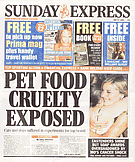 'In
one experiment, 24 young dogs had their right kidneys removed and
the left partly damaged to investigate how protein affects dogs
with kidney failure. Eight dogs were killed to analyse the kidney
tissue. Dogs which became sick were not treated because it would
have undermined the test results.
'In
one experiment, 24 young dogs had their right kidneys removed and
the left partly damaged to investigate how protein affects dogs
with kidney failure. Eight dogs were killed to analyse the kidney
tissue. Dogs which became sick were not treated because it would
have undermined the test results. 



©2008Pet Food Choice - All information on this website is given in good faith, but decisions about the feeding requirements of your pets are entirely up to you, or if necessary should be taken with the help and advice of your veterinary surgeon... Site map - Cookies
